Why Smart Bulbs Stop Working When Someone Uses the Wall Switch
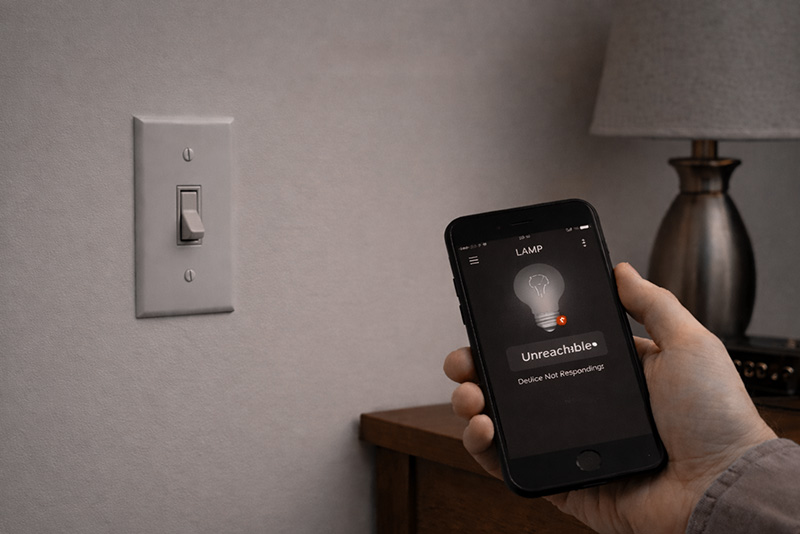
A smart bulb lamp stopped working because the wall switch got turned off.

Smart bulbs promise convenience.

You set them up.
You connect the app.
You create schedules and scenes.

And then someone flips the wall switch — and everything breaks.

If this has happened in your home, you’re not doing anything wrong. It’s a fundamental conflict between how smart bulbs work and how people actually use wall switches and lamps.


Smart Bulbs Need Constant Power

Smart bulbs rely on the electronic circuitry inside the bulb itself.

For those electronics to work, the bulb needs:

  • Continuous power at the outlet

  • An active connection to your WiFi network

  • A light bulb socket that is powered all the time

When someone flips the wall switch off, the bulb loses power entirely.

That means:

  • The app can’t find it

  • The WiFi connection breaks
  • Automations stop

  • Voice control fails

  • Schedules don’t run

The bulb isn’t just “off.”
It’s completely disconnected.

And it’s not just wall switches that can cause problems.

Smart bulbs can also stop working if someone turns the lamp’s own switch off.

Many lamps have rotary knobs or inline switches, and flipping those cuts power to the bulb just as completely as a wall switch does. Once that happens, the smart bulb goes offline, disappears from the app, and stops responding to schedules or voice commands.

From the user’s perspective, it feels random — but it’s the same underlying issue: smart bulbs can’t function without uninterrupted power.


Why This Is Especially Frustrating in Apartments

In apartments and single family homes:

  • Wall switches are still the primary way people expect lights to work

  • Guests, kids, and babysitters use switches instinctively

  • Switch-controlled outlets are common

Smart bulbs quietly assume:

  • Everyone knows not to touch the switch

  • Lighting is app-first

  • Physical controls are secondary

That assumption doesn’t match real life.


The Guest Problem Nobody Talks About

One of the biggest issues with smart bulbs has nothing to do with technology.

It’s usability.

If someone has to be told:

“Don’t use the wall switch — use the app instead”

…the system is already fragile.

Guests don’t want instructions.
Babysitters don’t want to use apps.
Family members don’t remember rules.
And on top of all that, you don’t want the security risks of everyone having access to your system.

Lighting should work the same way for everyone.


Why Smart Bulbs Feel Unreliable (Even When They Aren’t Broken)

From the user’s perspective, smart bulbs feel unreliable because:

  • Sometimes they respond

  • Sometimes they don’t respond

  • Sometimes the app works

  • Sometimes it says the device is offline

In reality, the bulb is behaving exactly as designed — it just wasn’t designed for normal wall-switch or lamp switch use.

That mismatch creates constant friction.


Why This Leads to Abandoned Smart Lighting

This is why so many people eventually:

  • Stop using the app

  • Disable smart features

  • Replace the bulbs altogether

The technology works — but the experience doesn’t.

Especially in shared homes and rentals, reliability beats novelty.


A Better Approach Starts With the Switch

Instead of fighting wall switches, a better lighting setup works with them.

That means:

  • Physical switch controls still matter

  • One action can be configured to affect multiple lights

  • Lighting controls should work even if the internet is down

  • Anyone should be able to use it

For many people, the simplest systems end up being the most dependable.


Smart Doesn’t Always Mean Better

Smart bulbs are impressive pieces of technology — but they aren’t always the right tool for the job.

If turning on a light requires:

  • Explaining how it works

  • Avoiding physical switches

  • Troubleshooting connectivity

  • Increasing home WiFi security risks

…it may be solving the wrong problem.

If you want lighting that works with wall switches instead of fighting them—without apps or WiFi—you can reserve PSYNQ for $1 and lock in the VIP $40 price (retail ~$60): presale.psynq.com
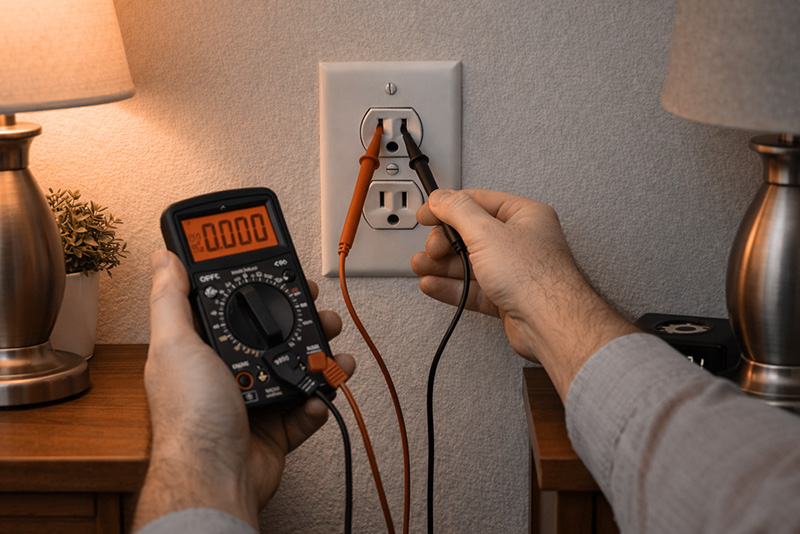

What Is a Half-Hot Outlet? (And Why It Confuses Everyone)

Testing a half-hot outlet to determine which plug in the outlet is controlled by the switch.

If you’ve ever plugged a lamp into an outlet, flipped the wall switch, and found that only one plug on the outlet is controlled by the switch — you’ve encountered a half-hot outlet.

Most people don’t know the term.
They just know something feels broken.

The good news: it’s not broken at all.
It’s just an outdated design that doesn’t make much sense anymore.


What a Half-Hot Outlet Actually Is

A half-hot outlet is a standard wall outlet where:

  • One plug is always on

  • The other plug is controlled by a wall switch

You can usually tell which is which by trial and error — or by noticing that only one lamp turns on when you flip the switch.

This setup was common in older homes and apartments, especially in rooms without overhead lighting.


Why Half-Hot Outlets Exist

Decades ago, builders used half-hot outlets as a cheaper alternative to installing ceiling lights.

The idea was simple:

  • Plug a lamp into the switched half

  • Use the wall switch to control your room lighting

On paper, it worked.

In reality, it assumed:

  • The lamp would stay in one place

  • Furniture layouts wouldn’t change

  • People wouldn’t need multiple light sources

None of that matches how people live today.


Why Half-Hot Outlets Are So Confusing

Half-hot outlets create problems because they’re invisible.

There’s:

  • No label

  • No indicator

  • No obvious difference between the two plugs

So people experience things like:

  • One lamp turns on, while another doesn’t

  • A phone charger works in one plug but not the other

  • The switch “controls nothing”

  • Outlets seem randomly broken

In apartments, this confusion often lasts for years.


Why They’re Especially Frustrating in Bedrooms and Living Rooms

Half-hot outlets are most annoying in rooms where lighting matters most.

In bedrooms:

  • There’s often no overhead light

  • The switch controls one random outlet

  • Bedside lamps may not be connected

In living rooms:

  • Lamps are spread across the space

  • Only one plug in one outlet responds to the switch

  • Lighting feels uneven and unfinished

The wiring dictates the room — instead of the other way around.


Why Rewiring Isn’t the Right Fix

Technically, half-hot outlets can be rewired.

But in practice:

  • It requires an electrician

  • Walls may need to be opened

  • It’s expensive

  • It’s usually not allowed in rentals

Most people simply live with the frustration.


The Modern Workaround (Without Rewiring)

The key is to stop thinking in terms of which outlet is controlled by the wall switch.

Instead, think about:

  • How you want the room to respond when you turn lights on

  • Where lamps actually make sense visually

  • How many lights should turn on together

A modern approach lets you:

  • Keep your outlets as they are

  • Place lamps anywhere

  • Synchronize lighting from a single action

  • Avoid changing the room’s wiring

The result feels intentional — even in older spaces.


Half-Hot Outlets Aren’t Broken — They’re Just Outdated

If a half-hot outlet has ever made you question your sanity, you’re not alone.

It’s a relic of older building practices colliding with modern living.

The good news is you don’t need to rewire your home to fix how the lighting functions and feels.

If you want to control and synchronize your lighting without rewiring, smart bulbs, or WiFi, you can reserve PSYNQ for $1 and lock in the VIP $40 price (retail ~$60): presale.psynq.com

Why Your Bedroom Switch Doesn’t Control a Light

Cozy bedroom with synchronized bedside lamp lighting.

If you’ve ever flipped the wall switch in a bedroom for the first time and nothing happened, you’re not imagining things — and there’s probably nothing “wrong” with your wiring.

This is one of the most common lighting frustrations in apartments and older homes.

You walk into a dark room, hit the switch, and… nothing turns on. No ceiling light. No lamp. Just darkness.

Here’s why that happens — and what you can do about it without having to call an electrician to change your wiring.


This Is Extremely Common in Bedrooms

Many bedrooms — especially in apartments and homes built decades ago — were never designed with overhead lighting.

Instead, builders often:

  • Installed a wall switch

  • Connected it to a single outlet

  • Assumed a lamp would be plugged in

If there’s no lamp plugged into that outlet, the switch appears to do nothing.

In some cases, the switch controls:

  • An outlet behind furniture

  • An outlet you don’t use

  • Half of an outlet that isn’t obvious (a half-hot outlet)

That’s why the room feels broken, even though it technically isn’t.


Why Bedrooms Often Don’t Have Overhead Lights

This design choice goes back decades.

Bedrooms were considered “lamp rooms,” not ceiling-light rooms. Installing overhead lighting cost more, so many builders skipped it and relied on switch-controlled outlets instead.

The result today:

  • No ceiling light

  • One awkwardly placed switch controlled outlet

  • Lighting that doesn’t match modern furniture layouts

And in rentals, rewiring usually isn’t an option.


Why Rewiring Isn’t a Realistic Fix

If you search online, you’ll see suggestions like:

  • Add a ceiling fixture

  • Run new wiring

  • Rewire the switch

  • Hire an electrician

Those solutions are:

  • Expensive

  • Disruptive

  • Often not allowed in apartments

Most people end up living with the problem because the “real” fixes aren’t practical.


The Practical, No-Rewiring Workaround

The key is to stop thinking of the wall switch as something that must control a ceiling light.

Instead, think of it as a simple on/off trigger that can control lighting elsewhere in the room.

That approach lets you:

  • Place lamps where they actually make sense

  • Light the room evenly

  • Turn lights on when you enter

  • Avoid making any changes to your wiring

In other words, you adapt the lighting to the room — not the room to the wiring.


Why This Matters for Bedrooms Specifically

Bedrooms are where this problem feels worst.

You don’t want to:

A lighting setup that responds instantly — from a single action — makes the room feel finished and intentional, even without an overhead light.


You’re Not Missing a Light — You’re Missing Control

If your bedroom switch doesn’t control a light, it’s not a flaw in your home.

It’s an outdated design assumption colliding with modern living.

The good news is that you don’t need to rewire anything to fix how the room feels and functions.

If you want your bedroom lighting to turn on instantly—without rewiring, smart bulbs, or WiFi—you can reserve PSYNQ for $1 and lock in the VIP $40 price (retail ~$60): presale.psynq.com