What Is a Half-Hot Outlet? (And Why It Confuses Everyone)
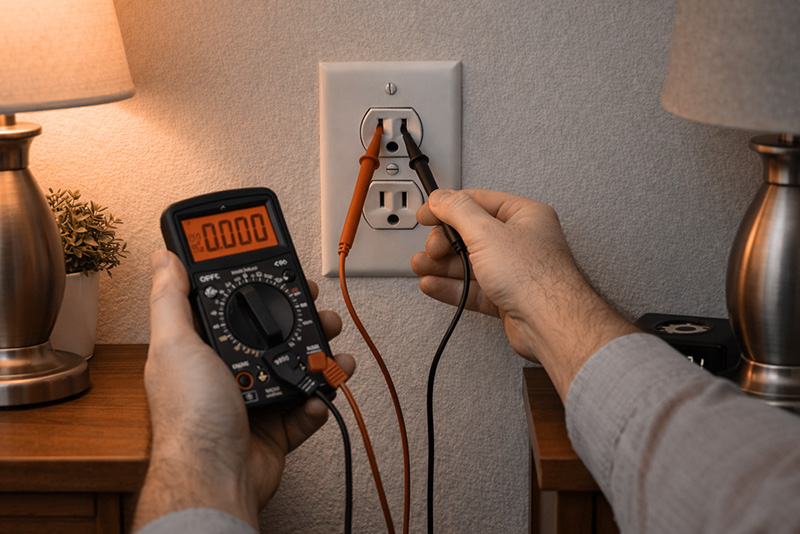
Testing a half-hot outlet to determine which plug in the outlet is controlled by the switch.

If you’ve ever plugged a lamp into an outlet, flipped the wall switch, and found that only one plug on the outlet is controlled by the switch — you’ve encountered a half-hot outlet.

Most people don’t know the term.
They just know something feels broken.

The good news: it’s not broken at all.
It’s just an outdated design that doesn’t make much sense anymore.


What a Half-Hot Outlet Actually Is

A half-hot outlet is a standard wall outlet where:

  • One plug is always on

  • The other plug is controlled by a wall switch

You can usually tell which is which by trial and error — or by noticing that only one lamp turns on when you flip the switch.

This setup was common in older homes and apartments, especially in rooms without overhead lighting.


Why Half-Hot Outlets Exist

Decades ago, builders used half-hot outlets as a cheaper alternative to installing ceiling lights.

The idea was simple:

  • Plug a lamp into the switched half

  • Use the wall switch to control your room lighting

On paper, it worked.

In reality, it assumed:

  • The lamp would stay in one place

  • Furniture layouts wouldn’t change

  • People wouldn’t need multiple light sources

None of that matches how people live today.


Why Half-Hot Outlets Are So Confusing

Half-hot outlets create problems because they’re invisible.

There’s:

  • No label

  • No indicator

  • No obvious difference between the two plugs

So people experience things like:

  • One lamp turns on, while another doesn’t

  • A phone charger works in one plug but not the other

  • The switch “controls nothing”

  • Outlets seem randomly broken

In apartments, this confusion often lasts for years.


Why They’re Especially Frustrating in Bedrooms and Living Rooms

Half-hot outlets are most annoying in rooms where lighting matters most.

In bedrooms:

  • There’s often no overhead light

  • The switch controls one random outlet

  • Bedside lamps may not be connected

In living rooms:

  • Lamps are spread across the space

  • Only one plug in one outlet responds to the switch

  • Lighting feels uneven and unfinished

The wiring dictates the room — instead of the other way around.


Why Rewiring Isn’t the Right Fix

Technically, half-hot outlets can be rewired.

But in practice:

  • It requires an electrician

  • Walls may need to be opened

  • It’s expensive

  • It’s usually not allowed in rentals

Most people simply live with the frustration.


The Modern Workaround (Without Rewiring)

The key is to stop thinking in terms of which outlet is controlled by the wall switch.

Instead, think about:

  • How you want the room to respond when you turn lights on

  • Where lamps actually make sense visually

  • How many lights should turn on together

A modern approach lets you:

  • Keep your outlets as they are

  • Place lamps anywhere

  • Synchronize lighting from a single action

  • Avoid changing the room’s wiring

The result feels intentional — even in older spaces.


Half-Hot Outlets Aren’t Broken — They’re Just Outdated

If a half-hot outlet has ever made you question your sanity, you’re not alone.

It’s a relic of older building practices colliding with modern living.

The good news is you don’t need to rewire your home to fix how the lighting functions and feels.

If you want to control and synchronize your lighting without rewiring, smart bulbs, or WiFi, you can reserve PSYNQ for $1 and lock in the VIP $40 price (retail ~$60): presale.psynq.com

Why Does My Wall Switch Control the Wrong Outlet? (And How to Fix It Without Rewiring)

Wall switch controlling the wrong outlet in a home office.

If you’ve ever flipped a light switch and watched a completely unexpected outlet turn on, you’re not alone.
This is one of the most common electrical frustrations in American homes — especially in bedrooms, apartments, and older living spaces with no overhead lighting.

But here’s the good news:
You can fix this problem without rewiring, without hiring an electrician, and without touching your breaker panel.

Let’s break down why this happens… and the easiest ways to solve it.


Why Does a Wall Switch Control the “Wrong” Outlet?

There are a few reasons this happens, and most of them have nothing to do with anything you did.


1. Homes Without Overhead Lighting (Very Common)

Many homes — especially older ones or apartments — were built with no ceiling lights.
To give you some way to turn on a lamp when you enter the room, builders added:

  • One half-hot outlet (only the top or bottom receptacle is switch-controlled), or

  • One single outlet on the entire wall that responds to the switch

Problem is… the outlet they chose might not be the one you actually use.


2. Furniture Layout Changes Everything

Let’s say the builder put the switched outlet on the left wall.
But you moved your bed or couch to the right wall.

Now:

  • The switch no longer controls the outlet you want

  • Your lamp turns on across the room

  • Or nothing turns on at all

This is the most common scenario in rentals.


3. Previous Owners Rewired Half the Room (or Just One Outlet)

Sometimes the previous homeowner:

  • Removed a switched outlet

  • Changed which half was controlled

  • Added or replaced outlets incorrectly

  • Upgraded part of the room but not all of it

You inherit whatever wiring choices they made.


4. Builders Sometimes Choose the “Easiest” Outlet to Wire

Not the best one.
Not the logical one.
Just the one closest to the switch or easiest to reach in the wall.

This leads to baffling setups like:

  • Switch by the door → controls outlet behind the sofa

  • Switch in hallway → controls bedroom outlet

  • Switch controls only the top plug

  • Switch controls only the bottom plug

You’re not imagining it — it’s wild.


Traditional Fixes (And Why Most People Can’t Use Them)

If you search online, you’ll see suggestions like:

  • “Hire an electrician.”

  • “Rewire the outlet.”

  • “Cut open the drywall.”

  • “Add new switch wires.”

These options cost $200–$1000+ and are not allowed in rentals.

That’s why most people simply live with the problem…
and keep walking into a dark room.


A No-Rewiring, Renter-Friendly Fix

If you want a simpler, plug-in solution, here’s the modern workaround:

Use the switched outlet to control any other outlet in the room.

This is exactly why I created PSYNQ — a plug-and-play device that lets you:

  • Move switch control to any outlet

  • Sync multiple lamps to the same switch

  • Use one lamp to control multiple other lamps
  • Fix bad outlet placements instantly

  • Add switch control to dark corners

  • Get lighting control without WiFi or rewiring

You simply plug the transmitter into the switch-controlled outlet…
…plug your lamp or device into the receiver…
…and the wall switch now controls THAT outlet instead.

No wiring.
No apps.
No accounts.
No tools.

If you want early access and the VIP $40 prelaunch price (retail ~$60), you can reserve one for $1 at presale.psynq.com.


When Should You Use a System Like This?

Here are the most common scenarios:

✔ Bedroom without ceiling lights

You want the switch to control the outlet by your nightstand, not the random outlet across the room.

✔ Living room furniture doesn’t match the builder’s outlet choices

Switch controls the wrong wall? Fixable instantly.

✔ Rental unit where you can’t rewire

You need a temporary but reliable solution.

✔ Home office setup

Want your desk lamp to respond to the wall switch? Easy.

✔ Home theater rooms

Sync multiple lamps to one switch for ambience.


Final Thoughts: You’re Not Crazy — Your House Wiring Is

If your wall switch is controlling the wrong outlet, you’re dealing with a very common, very fixable problem.

You don’t need an electrician.
You don’t need rewiring.
You don’t need smart bulbs or a smart home hub.

You just need a way to take control of your outlets again.

Reserve the VIP $40 prelaunch price for $1 and get notified when PSYNQ launches: presale.psynq.com